Thermal weeding is increasingly popular among municipalities, landscapers, and professionals responsible for maintaining outdoor spaces. As an effective alternative to phytosanitary products, it fits perfectly within zero-chemical and sustainable management approaches.
However, a common misconception persists: to be effective, weeds must be burned until they turn black.
In reality, this is false.
Worse still, this practice can reduce the effectiveness of thermal weeding. So, should plants really be burned? How does this method actually work? And most importantly, what is the right approach in the field?
Here’s everything you need to know.
A common misunderstanding about thermal weeding
In the collective imagination, “thermal weeding” is often associated with visible flames and charred vegetation. This perception comes from older methods or certain equipment using a direct, flexible, and long flame, typical of traditional burners.
As a result, many users believe they must continue until the plant visibly burns for the treatment to be effective.
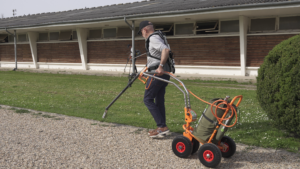
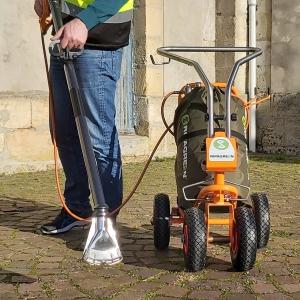
Thermal weeding developed with Ripagreen technology does not aim to burn the plant, but to induce thermal shock by heating it to a high temperature, enough to destroy it. Its pulsed hot air technology produces a short, rigid flame combined with a blade of hot air. The heat is directed toward the ground in a powerful flow, unlike conventional burners. As a result, a quick pass of 2 to 3 seconds at 20 cm from the plant is enough to burst the plant cells.
The real principle: rapid thermal shock
The operation of thermal weeding is both simple and highly effective. When a plant is exposed to intense heat for a short period: • plant cells burst • cell walls break down • sap can no longer circulate properly
Result: the plant dries out and gradually dies.
This process occurs well before any visible combustion. In other words, trying to burn the plant is unnecessary and even counterproductive
How to check if the treatment is effective
Contrary to popular belief, the effectiveness of thermal weeding cannot be judged by immediate visual appearance.
A plant may appear intact right after treatment, but in reality, it is already doomed. The right approach is to observe the texture of the leaves: • they become dull • they lose rigidity • they take on a slightly wilted appearance
A simple test is to press a leaf with your finger after treatment: if your fingerprint remains visible, thermal shock has occurred.
Conversely, a blackened or charred plant indicates that you have applied too much heat.
Why burning weeds is a mistake
Trying to burn plants presents several major drawbacks.
A waste of time Spending more time on each area significantly slows down the work. On large surfaces, this directly impacts productivity.
Excessive gas consumption The longer the exposure time, the higher the energy consumption, without any real gain in effectiveness.
Increased risks Excessive heat can damage: • surfaces (asphalt, paving stones) • street furniture • edges and sensitive elements
It also increases risks for the operator and the surrounding environment.
Misleading effectiveness Burning the visible part of the plant does not guarantee better destruction of the roots, especially for perennial species.
In thermal weeding, efficiency is not measured by the flame, but by control of the technique, an approach perfectly embodied by Ripagreen technology.
You may also be interested in
08Jul2025Thermal weeding: safety, efficiency and good practice with Ripagreen®
Thermal weeding is now established as a sustainable, chemical-free solution for maintaining public and private spaces. At Ripagreen®, safety of use is a central pillar of our technology. Thanks to […]
19Mar2025When should I start my thermal weeding with Ripagreen®?
The return of fine weather also means the return of weeds. Depending on the region, the thermal weeding season is starting or has already started, and it’s essential to get […]
16May2023Comparison between a traditional burner and our Ripagreen® tools
When it comes to comparing and choosing a weed control method that does not use phytosanitary products, there is a wide choice of equipment. There are steam, foam, infrared and […]
To provide the best experiences, we use technologies such as cookies to store and/or access device information. Consenting to these technologies will allow us to process data such as browsing behaviour or unique IDs on this site. Failure to consent or withdraw consent may adversely affect certain features and functions.
Functional
Always active
The storage or technical access is strictly necessary for the legitimate purpose of enabling the use of a specific service explicitly requested by the subscriber or user, or for the sole purpose of carrying out the transmission of a communication over an electronic communications network.
Preferences
The storage or technical access is necessary for the legitimate interest purpose of storing preferences that are not requested by the subscriber or user.
Statistics
Storage or technical access that is used exclusively for statistical purposes.Technical storage or access which is used exclusively for anonymous statistical purposes. In the absence of a subpoena, voluntary compliance by your internet service provider or additional third party records, the information stored or retrieved for this sole purpose generally cannot be used to identify you.
Marketing
The storage or technical access is necessary to create user profiles in order to send advertisements, or to track the user on a website or on several websites with similar marketing purposes.